
Health and safety (santé et sécurité)
Safety Is Planned, Not Improvised.
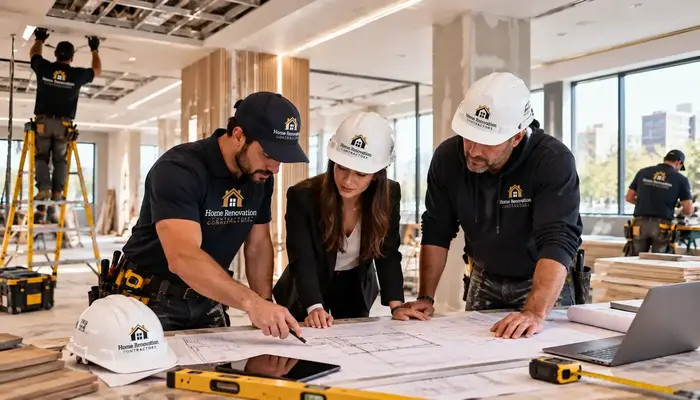
Home Renovation Contractors plans health and safety into every project, residential and commercial, across Greater Montreal, Laval and the North and South Shores.
In Quebec, workplace health and safety on construction sites is governed by the CNESST. Construction workers must complete the general construction health and safety course before working on sites, and employers must identify and control hazards on each job.
Renovations bring specific risks: dust, older materials such as asbestos or lead paint in older buildings, work at height, electricity and heavy materials. We identify them before work starts and set the right controls.
Safety is part of our project management, commercial renovations and every home renovation.
Common renovation hazards
Risks We Plan For on Every Job.
Each hazard has a control measure planned before work begins.
Dust and debris
Dust barriers, floor protection and daily cleanup, especially in occupied homes.
Older materials
Buildings of a certain age may contain asbestos or lead paint; suspect materials are tested before demolition.
Work at height
Ladders, scaffolding and fall protection used correctly.
Electrical hazards
Circuits isolated and work done by licensed electricians.
Openings and stairs
Guards and signage around openings and temporary stairs.
Public and occupants
Work areas separated from family, staff and customers.
How we keep sites safe
Health and Safety Practices.
Safety measures built into every stage of the project.
Planning and training
Hazards identified for each project; workers trained and qualified for the tasks they perform.
✓ The right people for each task.

Site controls
Protective equipment, fall prevention, secure storage of tools and materials, and safe access.
✓ A site that stays under control.

Dust and clean-up
Dust barriers, protection of floors and furniture, and daily cleanup in occupied spaces.
✓ Your home stays livable.
Hazards and controls
Typical Renovation Hazards and How They Are Controlled.
A summary of the controls we plan for.
| Hazard | Where it appears | Control |
|---|---|---|
| Dust | Demolition, sanding, drywall | Barriers, ventilation, cleanup |
| Suspect materials | Older plaster, insulation, flooring | Testing before demolition, qualified removal |
| Falls | Ladders, stairs, scaffolding | Proper equipment and guards |
| Electricity | Rewiring and demolition | Isolation, licensed electricians |
If testing confirms hazardous materials, removal is done by qualified specialists following applicable rules.
Step by step
How Safety Is Managed on a Project.
From the first visit to handover.
Site assessment
We look at the building, its age, access and occupants.
Hazard plan
Risks listed with the controls for each task.
Testing if needed
Suspect materials tested before demolition.
Site setup
Barriers, signage, protection and secure storage.
Daily practices
Protective equipment, safe access and daily cleanup.
Inspections
Regular checks of the site and equipment.
Clean handover
Site cleaned and secured before you move back in.
Before you compare quotes
What Affects Safety-Related Costs.
Safety is part of a professional quote; these factors change its scope.
Building age
Testing older materials before demolition.
Occupied spaces
More dust control and phasing.
Work at height
Scaffolding or lifts for exteriors.
Hazardous materials
Specialized removal if testing is positive.
Commercial sites
After-hours work and separation from the public.
Duration
Longer projects need ongoing site controls.
Who regulates construction site safety in Quebec?
The CNESST (Commission des normes, de l’équité, de la santé et de la sécurité du travail) oversees workplace health and safety, including construction sites.
Do your workers have safety training?
Construction workers in Quebec must complete the general construction health and safety course before working on sites, and we assign qualified workers to each task.
What if my house has asbestos?
Older buildings can contain asbestos in some materials. Suspect materials are tested before demolition, and any removal is done by qualified specialists following applicable rules.
How do you control dust in an occupied home?
With dust barriers, floor and furniture protection, careful demolition methods and daily cleanup.
Can you work in my business while it stays open?
Often yes, with phasing, separation of work areas, after-hours work for noisy tasks and clear signage.
Who is responsible for safety on my renovation?
As the contractor, we are responsible for organizing safe work on the site we manage.
Get started
Questions About Safety on Your Project?
Tell us about the building, who will be on site and your concerns. We will explain how we would plan the work safely.
- Type and age of the building
- Who occupies it during the work
- Any known concerns (dust, materials)
Serving all seven areas of Greater Montreal · all renovation services · renovation FAQ
Ask About Site Safety
Replies with clarifying questions — not a robocall.